-
Larger, Healthier Plants
More Value for Your Garden -
Nationwide Free Delivery
Fresh Plants to Your Doorstep -
Easy Online Shopping
Your Dream Garden in a Few Clicks


Fargesia Robusta 'Wolong' Bamboo
Fargesia Robusta 'Wolong' Bamboo
Couldn't load pickup availability
USDA Zones/Minimum Temperature
USDA Zones/Minimum Temperature
The 'Wolong' grows in temperatures as low as -10°F, making it a resilient choice for colder climates. It is well-suited for USDA zones 6 through 10.
- Every Order Ships Free
- Use code SAVE10% on orders over $50
- Guaranteed to Arrive Alive.
Fargesia Robusta 'Wolong' Bamboo
The Fargesia robusta ‘Wolong’ is a nice midsize clumping bamboo that makes a beautiful privacy screen, hedge or specimen. It grows to about 16′ tall, which is a little taller than most other types Fargesia. Here in the Pacific North West we grow ours in full sun with no adverse effects, but if you live in an area of high summer heat we recommend that you protect it from hot summer afternoon sun. Morning sun should be fine. One of the big differences between the ‘Wolong’ and our regular Robusta is the leaf size. The ‘Wolong’ has nice, shiny large foliage that is almost twice the size of the Fargesia robusta. The green culms emerge in the Spring with red to orange sheathing. This is a very nice, rare bamboo that would make a nice addition to a plant collection.
High heat mixed with high humidity would probably be fatal for the Fargesia, so this might not be a plant for those in the southeast states. Try instead, any of our Bambusa multiplex or Thamnocalamus.
Fargesia Robusta
Common name: Wolong
Height x Diameter: Ht 12′-16′ x .75”
Minimum temperature: Hardy to 0ºf
USDA zone: 7-9.
Light: Full sun to part shade
Culm: Green culms with orange-red sheathing
Uses: Specimen, hedge, container, screen
Distribution: Sichuan, China
Spread: Clumping
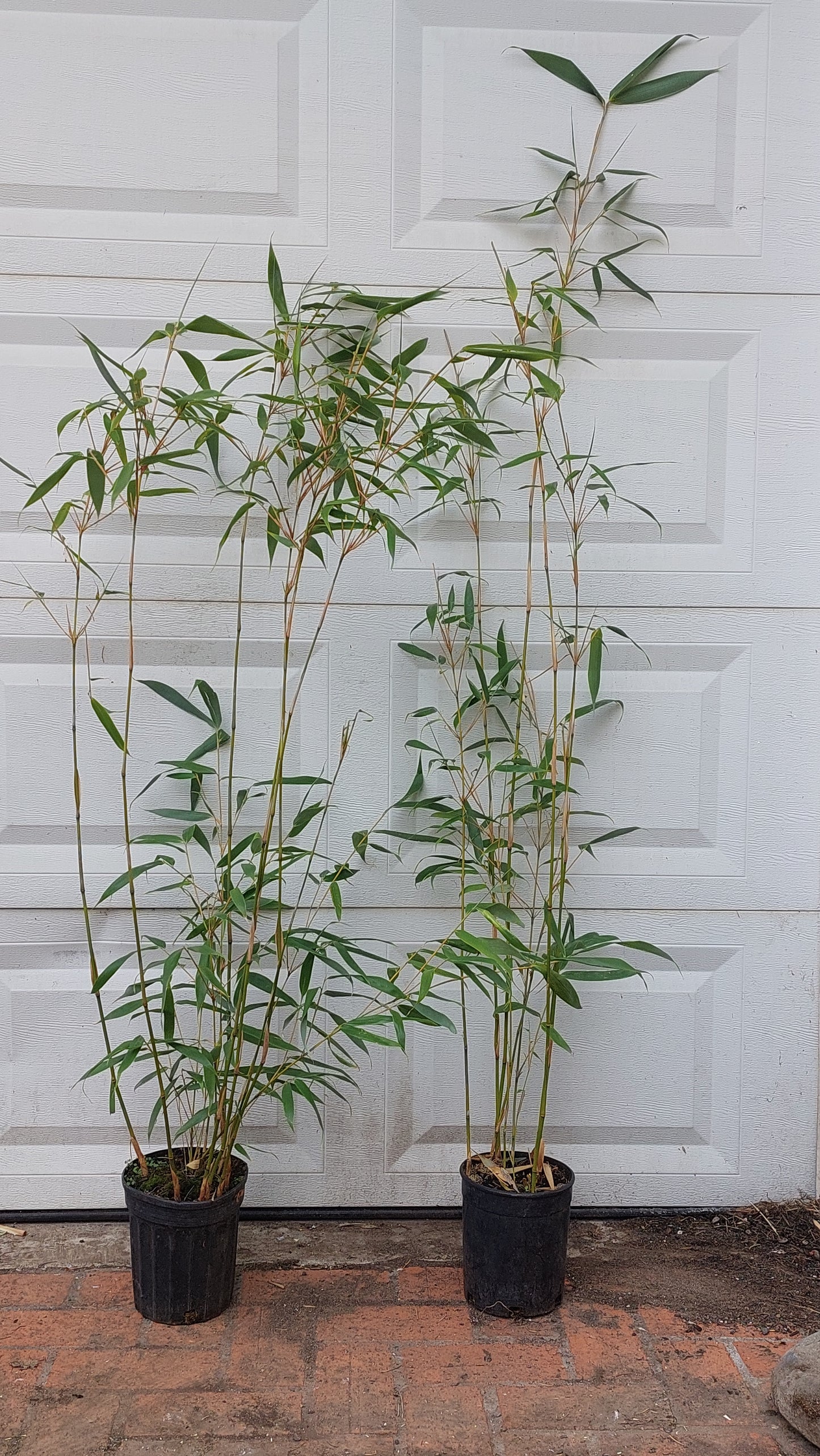
The last three photos are examples of our Fargesia Robusta 'Wolong', however, they are not the exact plants that you would receive. Your plant will be approximately 2-3 years old, 1'-5' tall (depending on container size), with 1-3 culms (canes).
Plant Highlight
Plant Highlight
Height: 12′-16′.
Minimum temperature: Hardy to -10ºf.
USDA zones: 6-10.
Light: Full sun to part shade.
Culm: Green culms with orange-red sheathing.
Uses: Specimen, hedge, container, screen.
Pollination and Ripening
Pollination and Ripening
Most bamboo species bloom very infrequently (some only once every 50–120 years). Bamboo flowers are usually wind-pollinated, not insect-pollinated. Male flowers release pollen, which the wind carries to female flowers. Fertilization produces seeds, but in many bamboo species, seeds are rare or may not be viable.
Shipping Restrictions
Shipping Restrictions
Cannot ship to HI.
Planting Guide
Planting Guide
Bamboo Planting and Care Guide
1. Soil and Site Selection
- Preferred Soil:
Bamboo thrives in moist, well-drained soil. Avoid waterlogged or swampy conditions, as they can cause root rot. - Clay Soil:
Heavy clay is generally too compacted for healthy bamboo growth. It is often too wet in winter and too dry in summer. Avoid planting directly into clay soil. - Planting Technique in Poor Soil:
Do not dig a large hole and fill it with potting soil (this creates a “soup bowl” effect, which can lead to root rot). The best approach is to loosen the native soil and plant into it directly, or mound potting soil or compost above the ground and plant your bamboo in it. Mounding keeps roots and rhizomes higher up in the native soil and simplifies rhizome management. - Sunlight Requirements:
Some bamboo varieties prefer full sun, while others thrive in shade. Observe your site’s sun exposure, especially during the hottest part of the day, before selecting a bamboo type.
2. Planting and Rhizome Management
- Bamboo may occasionally send rhizomes slightly above the soil before they extend underground, especially if you have planted in above ground mounds. These can be easily removed before they run below ground.
- Use mounding in combination with root pruning or a barrier for better rhizome control.
- Bamboo makes a wonderful container plant. Consider planting in large containers. If the container is on bare ground, place a large stepping stone or another solid object underneath it. Any rhizome that escapes out of the bottom drain holes will be deflected sideways and will be easier to manage.
- Clumping types do not need to be contained. They behave similar to an ornamental grass, getting wider at its base as it grows and matures.
3.Watering and Irrigation
- First Year:
Bamboo needs consistent watering to establish roots. - How Much Water:
It will depend on soil type, mulching, rainfall, and temperature. Keep the root ball moist, and allow some slight drying between waterings. In summer, bamboo leaves can curl during the hottest part of the day. Once it cools back down, the leaves will open back up. On our established plantings, we’ve seen this go on for days before they get watered. Younger, newer plantings should be watered right away.
4.Fertilizing
- Nutrient Preferences:
Bamboo loves nitrogen and slightly acidic soil (pH 5.5–6.5).
- Fertilizing Schedule:
For bamboo, top-dressing once a year with a high-nitrogen time release fertilizer (like 22-5-10 or 20-10-10) is preferred because bamboo focuses on leafy and culm growth. Avoid fast-release chemical lawn fertilizers as they are too " hot” and may burn plants. Lawn fertilizers would be labeled something like 30-0-0 or 50-0-0.
Organic fertilizer such as manures, guano, corn gluten, blood meal, and compost are excellent choices that also work well for bamboo. They would need to be applied more often than once a year.
Weekly watering with liquid nitrogen and iron added to the water can boost growth. Iron will slightly acidifies the sol.
The best time for fertilizing is just before new growth emerges from late March to early May.
5. Pruning and Maintenance
- Running types pruning Needs: Bamboo does not necessarily need regular pruning.
Prune to:
Remove dead culms and branches annually.
Thin groves or hedges to expose colorful culms.
Bamboo can be pruned like a hedge (similar to Photinia, Laurel, or Privet).
- Dwarf Bamboo:
Can be mowed yearly to maintain fullness and health.
- Clumbing types:
Can be prunned to remove any dead culms or to control height and width, if needed.
Chill Hours
Chill Hours
Share